Course catalogue.
Master silicon engineering from your browser. Professional paths for every skill level.
Browse
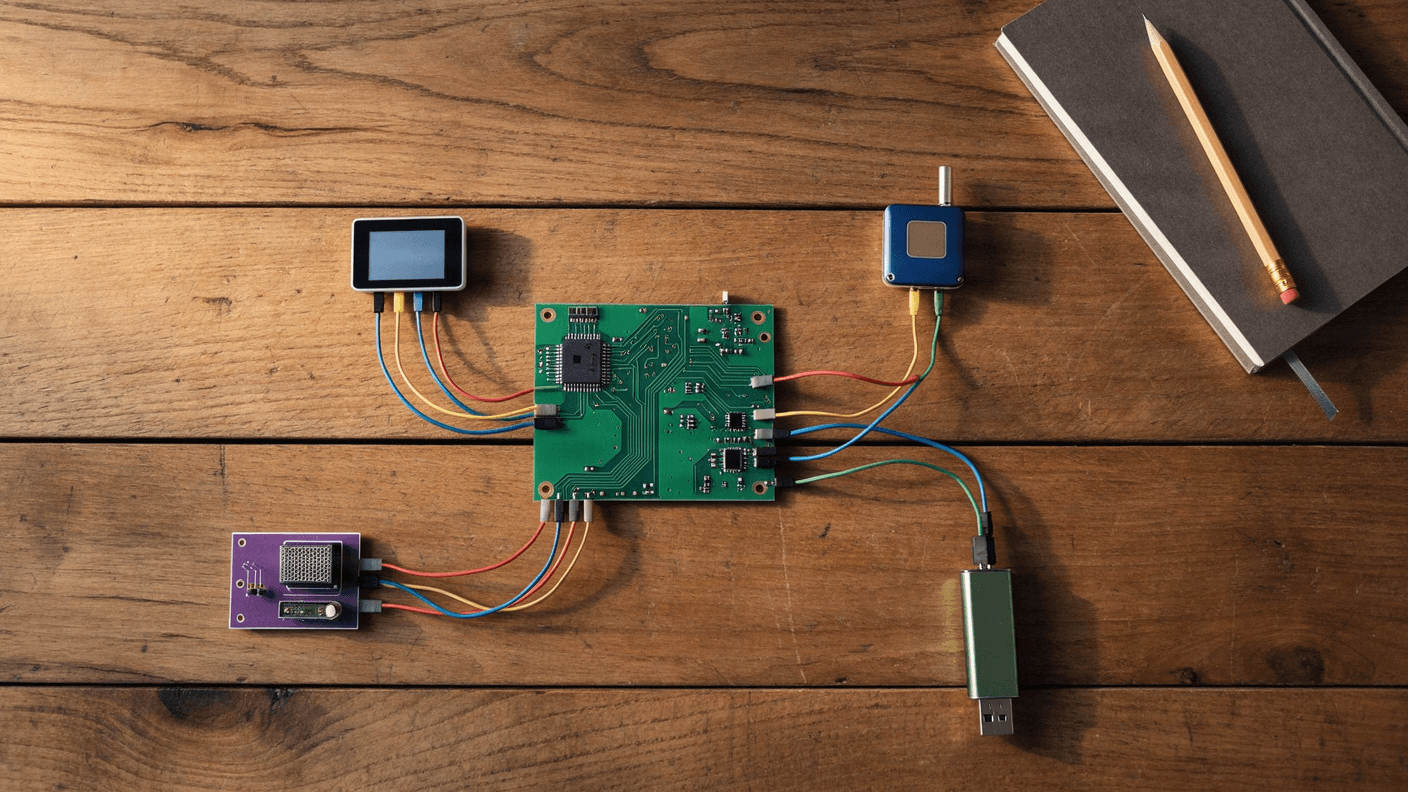
Chip Interfaces 1: Talking Between Chips
From pins to bytes. Part one of two. You design the chip inside a small data logger and give it a way to talk to the world, one link at a time: a UART that prints to a laptop and hears a GPS module, valid/ready handshakes and FIFOs that carry the bytes inside, SPI to a flash chip, and I2C, from the open-drain wire up to reading a real temperature sensor from its datasheet, on two wires a clock chip and a screen can share. Every idea starts from a real problem, and every module ends with your own blocks assembled into a working link, checked by a testbench you learn to read and write. It needs Digital Design Fundamentals and teaches the testbench skills it uses. It teaches Verilog on Icarus in your browser; it does not cover VHDL, vendor tools or timing closure, and it does not promise a job. Part two, Chip Interfaces 2: Talking Inside a Chip, builds what sits behind the pins.

Digital Design Fundamentals
From voltages and bits to state machines. Build the core of digital hardware: gates, multiplexers, adders, registers and FSMs, with live circuits you can poke and real Verilog you simulate along the way.

Introduction to ASIC Design
Take your digital designs from code to real silicon. Learn the modern ASIC manufacturing flow: synthesis, technology mapping, floorplanning, static timing analysis (STA), clock trees, PPA optimization, and physical verification (DRC/LVS).

Introduction to Verilog
Start from zero and learn to describe real hardware in code. Build intuition for RTL, write combinational and sequential circuits, run real simulations, and finish with a complete ALU design brief.
Learn chip design in your browser
Vulkos courses teach digital design and Verilog with lessons you can run as you read. Write RTL, simulate it against a testbench, and follow your design through synthesis and layout on the open-source toolchain. Nothing to install, and the first three modules of Digital Design Fundamentals need no account.
- Chip Interfaces 1: Talking Between Chips: From pins to bytes. Part one of two. You design the chip inside a small data logger and give it a way to talk to the world, one link at a time: a UART that prints to a laptop and hears a GPS module, valid/ready handshakes and FIFOs that carry the bytes inside, SPI to a flash chip, and I2C, from the open-drain wire up to reading a real temperature sensor from its datasheet, on two wires a clock chip and a screen can share. Every idea starts from a real problem, and every module ends with your own blocks assembled into a working link, checked by a testbench you learn to read and write. It needs Digital Design Fundamentals and teaches the testbench skills it uses. It teaches Verilog on Icarus in your browser; it does not cover VHDL, vendor tools or timing closure, and it does not promise a job. Part two, Chip Interfaces 2: Talking Inside a Chip, builds what sits behind the pins.
- Digital Design Fundamentals: From voltages and bits to state machines. Build the core of digital hardware: gates, multiplexers, adders, registers and FSMs, with live circuits you can poke and real Verilog you simulate along the way.
- Introduction to ASIC Design: Take your digital designs from code to real silicon. Learn the modern ASIC manufacturing flow: synthesis, technology mapping, floorplanning, static timing analysis (STA), clock trees, PPA optimization, and physical verification (DRC/LVS).
- Introduction to Verilog: Start from zero and learn to describe real hardware in code. Build intuition for RTL, write combinational and sequential circuits, run real simulations, and finish with a complete ALU design brief.