Chip design is opening up.
Open-source tools, open process kits and shared manufacturing runs now cover the whole path from Verilog to a chip. This page says what each one is, why it matters, and what you can do with it on Vulkos today.
Six things that changed.
Each one is something you can read about at its source, and most you can try.
Open-source design flows
A design flow turns Verilog into a layout. Yosys is a framework for Verilog synthesis. OpenROAD describes itself as an open-source autonomous toolchain for chip design, from RTL to a GDSII layout. LibreLane is infrastructure for building flows like this out of free tools. Anyone can run the same flow, read how it works and share a result that someone else can reproduce.
On Vulkos today. Write Verilog, simulate it, synthesise it with Yosys and run LibreLane to a finished layout, all in the browser. Yosys also runs inside your tab, in the Verilog to schematic view.
Sources: Yosys, yosyshq.net/yosys; OpenROAD, openroad.org; LibreLane, documentation; Google Open Source Blog, Open source PDKs joining the Linux Foundation’s CHIPS Alliance, November 2023.
Open process kits
A process design kit, or PDK, holds a foundry’s rules and cell libraries for one manufacturing process. Google and SkyWater released the first foundry-supported open-source PDK, for SkyWater’s 130 nm process, and GlobalFoundries followed with one for its 180 nm MCU process. Google’s open shuttle programme manufactured 360 designs from over 600 submissions from 19 countries, on eight SKY130 runs with 40 slots each.
On Vulkos today. Pick Sky130, GF180 or IHP SG13G2 for each project from the LibreLane menu, on every plan.
Sources: Google Open Source Blog, Open source PDKs joining the Linux Foundation’s CHIPS Alliance, November 2023; SkyWater PDK, github.com/google/skywater-pdk; GF180MCU PDK, github.com/google/gf180mcu-pdk.
Shared chip runs
A shuttle puts many small designs on one wafer, so each project pays for a small share of it. Tiny Tapeout says it makes it more accessible than ever to get your designs manufactured on a real chip. Its shuttles carry the names SKY, IHP and GF, for SkyWater, IHP and GlobalFoundries processes, and its prices depend on the size of the design and the shuttle, so it publishes a calculator.
On Vulkos today. Push a project from the IDE to a GitHub repository set up for Tiny Tapeout, on your own account, or download it as a zip. Making and paying for the chip happens on Tiny Tapeout.
Source: Tiny Tapeout, tinytapeout.com.
Verification in Python
cocotb is an open-source framework for testing hardware designs, and it says it lets you verify chips like software. Tests are written in Python and run against simulators including Icarus Verilog and Verilator. A student can check a design in a language they may already know.
On Vulkos today. Run cocotb tests on Icarus Verilog or Verilator from the IDE and open the waveform. A lecturer can set a cocotb lab and mark it question by question.
Source: cocotb, cocotb.org.
Tools in the browser and the cloud
Tools that once needed a workstation now run in a tab or on rented servers. YoWASP packages Yosys for WebAssembly, so synthesis can run inside a web page. That removes the install and the shared machine, which are the first things a lab has to solve.
On Vulkos today. Yosys runs in your browser for the schematic view. Simulation and layout run on our servers, so a student needs only a browser. At a workshop of 51 students on 13 October 2026, 21 chip layouts ran at once with an average wait of 0.1 seconds.
Source: YoWASP, github.com/YoWASP/yosys.
AI assistance in design work
Researchers are testing language models on chip design work. A 2023 paper from NVIDIA, ChipNeMo, evaluated an engineering assistant chatbot, EDA script generation, and bug summarisation and analysis. Its best result on simple EDA scripts was more than 70% correct, so the output still has to be checked, and the waveform and the tests are how you check it.
On Vulkos today. An assistant sits beside the editor. It can read the files in your project and propose edits that you apply with a click. Every plan has a weekly allowance of messages, and a lecturer can switch the assistant off for a lab.
Source: Liu et al., ChipNeMo, arXiv:2311.00176.
The whole path, in one sitting.
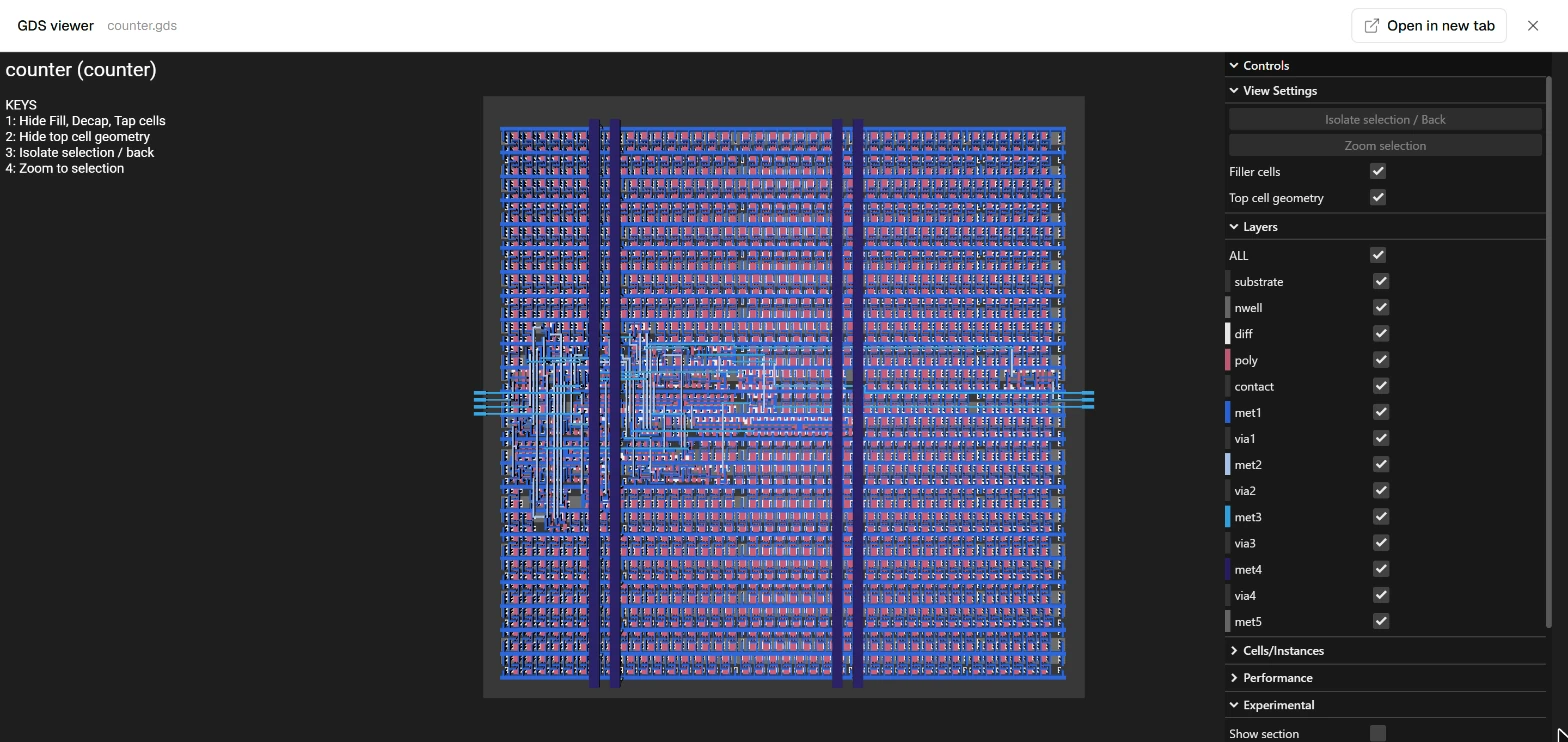
Put those six together and the path is open from end to end: write Verilog, check it with a Python testbench, turn it into gates, lay it out on an open process kit and, if you want a physical chip, send it to a shared run.
Not all of it is open. Production sign-off and analogue layout still belong to the commercial tools, and a chip from a shared run is made and paid for on Tiny Tapeout. Vulkos sits beside those tools, not in place of them.
To try it, start the free course or see the platform.
Take a design to layout yourself.
Open a project, write the Verilog and run the open flow.