Teaching chip design is harder than it should be.
Chips are designed on a computer long before anything is made, and most of that work can now be learned on an ordinary laptop. Yet the UK says it is short of people who can do it, and few students see a design all the way through to a layout.
This page sets out why, in four parts, with a public source under every figure. At the end it says what Vulkos does about each part.
The UK is short of people who can design chips.
The government’s workforce study counts about 27,245 people in the UK semiconductor sector and expects 39% of them to retire within 15 years. It estimates that the sector needs more than 10,000 additional workers by 2030.
About 870 graduates a year enter the sector, and nearly half of the employers surveyed feel that university courses, particularly undergraduate programmes, do not fully align with industry requirements. The 2023 National Semiconductor Strategy adds that over 80% of UK companies with any chip design capability are seeking new engineers.
It is not only a UK problem. In the United States, the Semiconductor Industry Association and Oxford Economics project a shortfall of 67,000 technicians, computer scientists and engineers in the chip industry by 2030.
Sources: Department for Science, Innovation and Technology, UK Semiconductor Workforce Study, April 2025; Department for Science, Innovation and Technology, UK Semiconductor Workforce Study, full report, April 2025; Department for Science, Innovation and Technology, National Semiconductor Strategy, May 2023; Semiconductor Industry Association and Oxford Economics, Chipping Away, July 2023.
What a teaching lab needs.
Teaching chip design on the commercial tools industry uses takes more than a licence.
Licences and paperwork
Academic licences come through EUROPRACTICE. For 2026-27 the Cadence IC package is 1,890 euros per licence for the first five, plus 1,905 euros a year per site, before VAT. The harder part is the process: paperwork is due by the 25th of each month, orders go in once a month per vendor, the annual charge is mandatory, and a missing item can hold an order up for weeks.
Sources: EUROPRACTICE, Price list 2026-2027; EUROPRACTICE, How to order.
Linux machines
On the same list, every tool in the Cadence IC package is supported on Linux, for example Red Hat Enterprise Linux 8 and 9. Windows is listed only for the systems and PCB packages. A lab needs Linux workstations or a remote Linux server, and a licence server whose host ID goes on the order form.
Source: EUROPRACTICE, Cadence primary packages.
Installs on student laptops
Students work on their own machines, and a toolchain that has to be installed and connected is a hurdle before the first lesson. In the feedback from our Riga workshop, 5 of the 33 comments on the best part were about not having to install anything.
Source: Vulkos, Riga workshop feedback form, October 2026.
Staff time
Someone sets up the licence server, the machines and each student’s account, and answers when something breaks. In our conversations with universities and student societies since October 2026, about seven accounts asked first for something with nothing to install or negotiate, and six for onboarding they would not have to repeat.
Source: Vulkos customer conversations, October to November 2026.
Layout comes late, or not at all.
Layout is where a design meets the physical chip: cells are placed, wires are routed and the result is checked against the process rules. It needs a flow, a process kit and a machine that can run them, so in most courses it comes late.
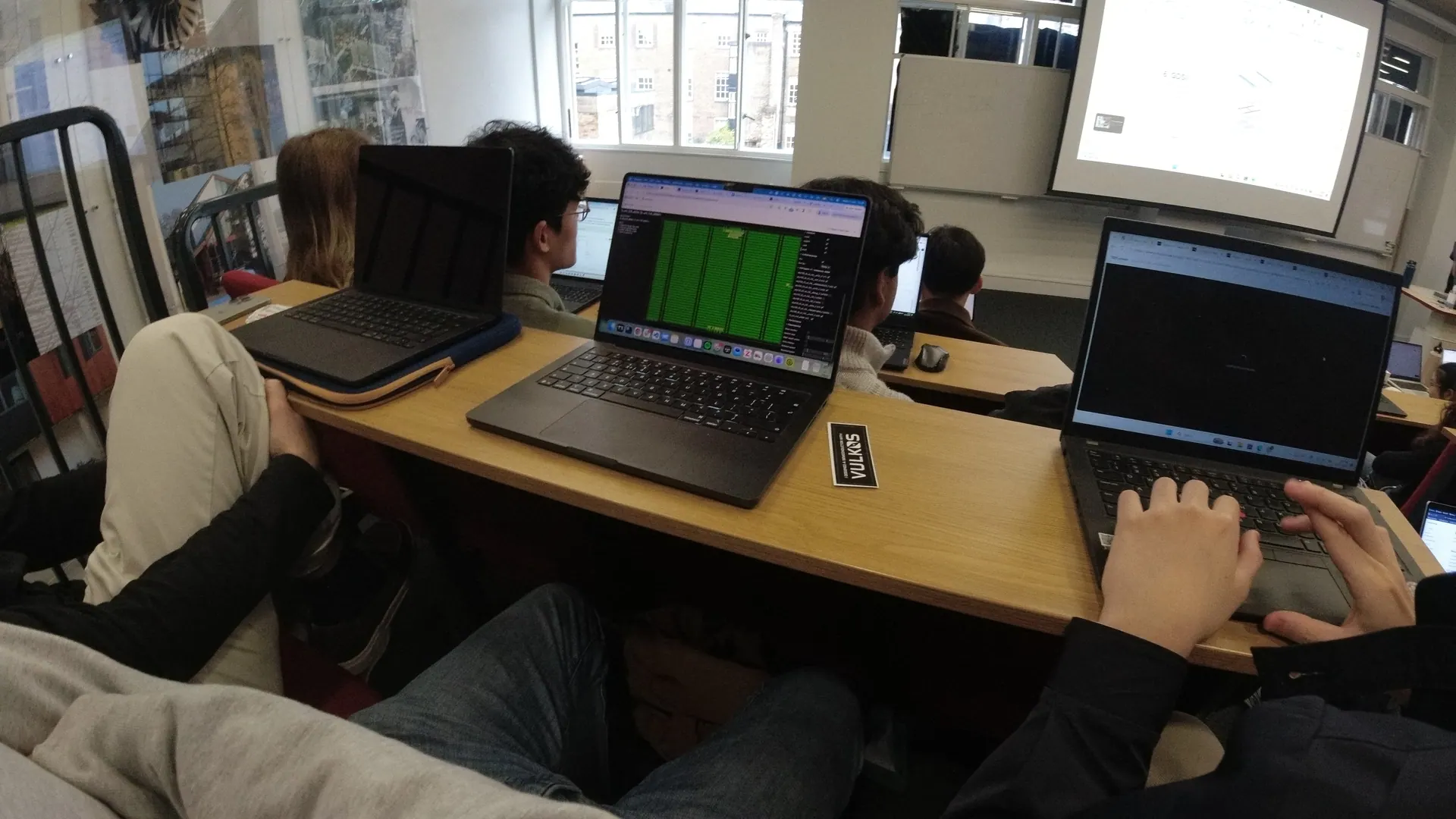
In our own reading of public module pages at about 38 UK and Irish universities in November 2026, about 9 showed any physical design at undergraduate level. We could not read every page, so this counts the ones we could.
The National Semiconductor Strategy points at the same gap. It says there is a gap between theoretical teaching and practical skills, and that for some roles people take more than two years before they can work unsupervised.
Sources: Department for Science, Innovation and Technology, National Semiconductor Strategy, May 2023; Vulkos review of public module pages, 12 November 2026.
A student starting out reads about chips but rarely makes one.
The workforce study finds that attraction to the sector from relevant courses is low: approximately 6% of graduates from relevant courses in the UK enter it. It says that raising awareness among first-year electrical and electronic engineering students, and sustaining their interest through the degree, could raise that share.
Interest is built by doing. A seat on commercial tools has to be ordered, installed and supervised, and teaching yourself with open-source tools means installing and connecting a toolchain with no one to ask.
Source: Department for Science, Innovation and Technology, UK Semiconductor Workforce Study, full report, April 2025.
What Vulkos does about it.
Four parts, four answers, each one something you can check on the platform. If you teach a module, start with Vulkos for universities.
See the platform| Where teaching gets stuck | What Vulkos does |
|---|---|
| Too few people learn chip design. | Digital Design Fundamentals is free, with automatically checked exercises, and runs from binary and gates to Verilog and the flow to silicon. The first modules need no account. |
| A lab needs licences, Linux machines, installs and staff time. | There is nothing to order or install. The open-source tools run on our servers and a student needs only a browser. A lecturer sets labs in a group, marking is automatic, and each student’s result shows in one place. |
| Few students reach a layout. | The layout flow, LibreLane on open process kits, runs in the browser. At a Cambridge workshop in October 2026, 69 of the 71 students in the group finished a chip layout, 65 of them on the day. |
| A student starting out has no way in. | It is free to start and there is nothing to set up. Projects are saved in the account, and can be published for others to fork, pushed to GitHub or sent on to Tiny Tapeout. |
Vulkos sits beside the commercial tools, not in place of them. Analogue layout and sign-off for production still belong on those.
See it with your own module.
Tell us what you teach and we will show you a lab built for it.