Workshop, 21 October 2026
A workshop of 71 students, and then a module.
In October, 69 of the 71 students in the workshop group finished a chip layout. This term an MPhil module is running its coursework on Vulkos.
- 69 of 71
- students in the workshop group finished a chip layout
- 30 min
- median time from first action to first finished layout, in a guided session
- 791
- runs in the three weeks after the workshop week, 267 of them chip layouts
From platform records of the workshop group, to Thursday 12 November 2026.
The setting
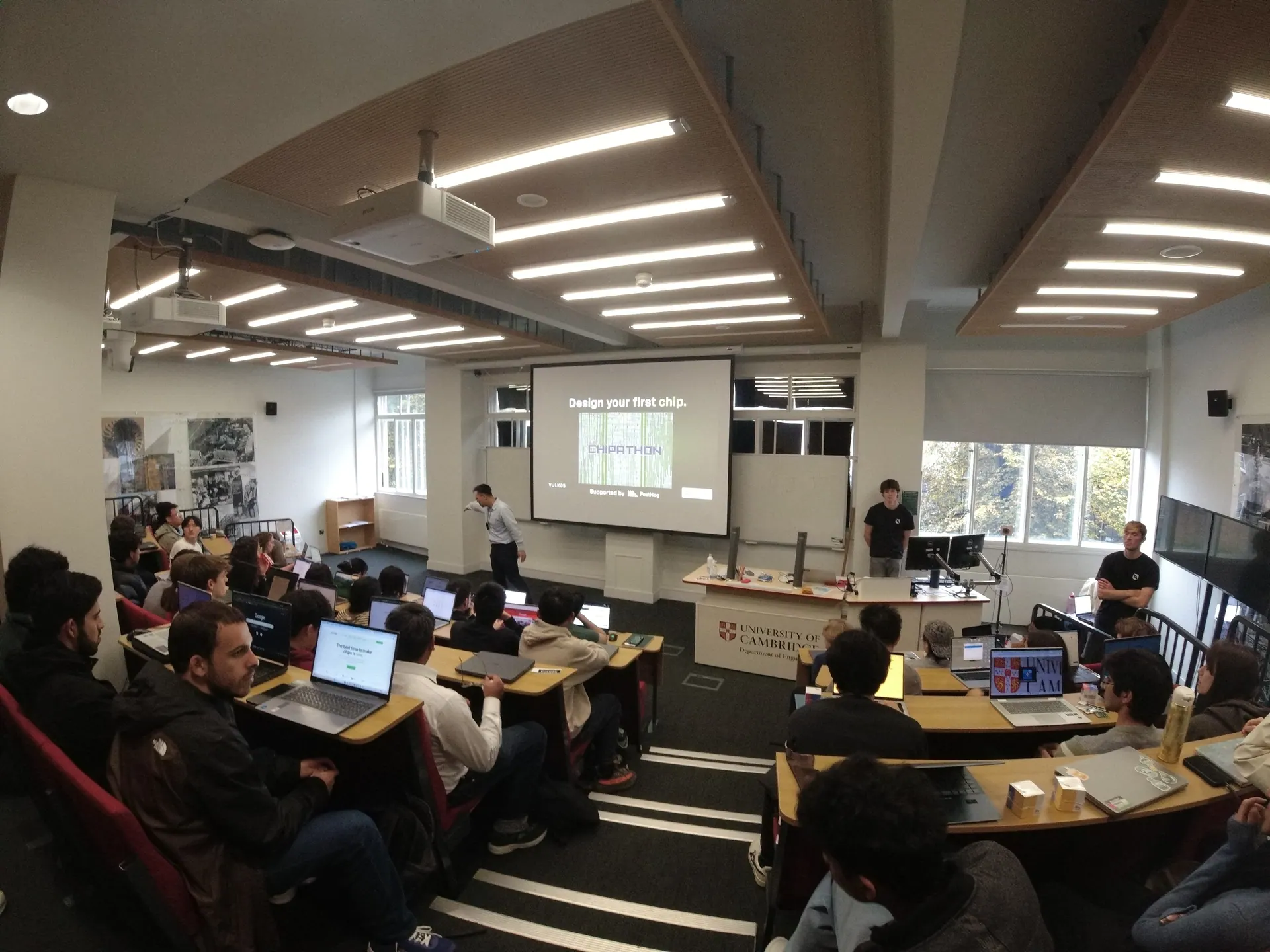
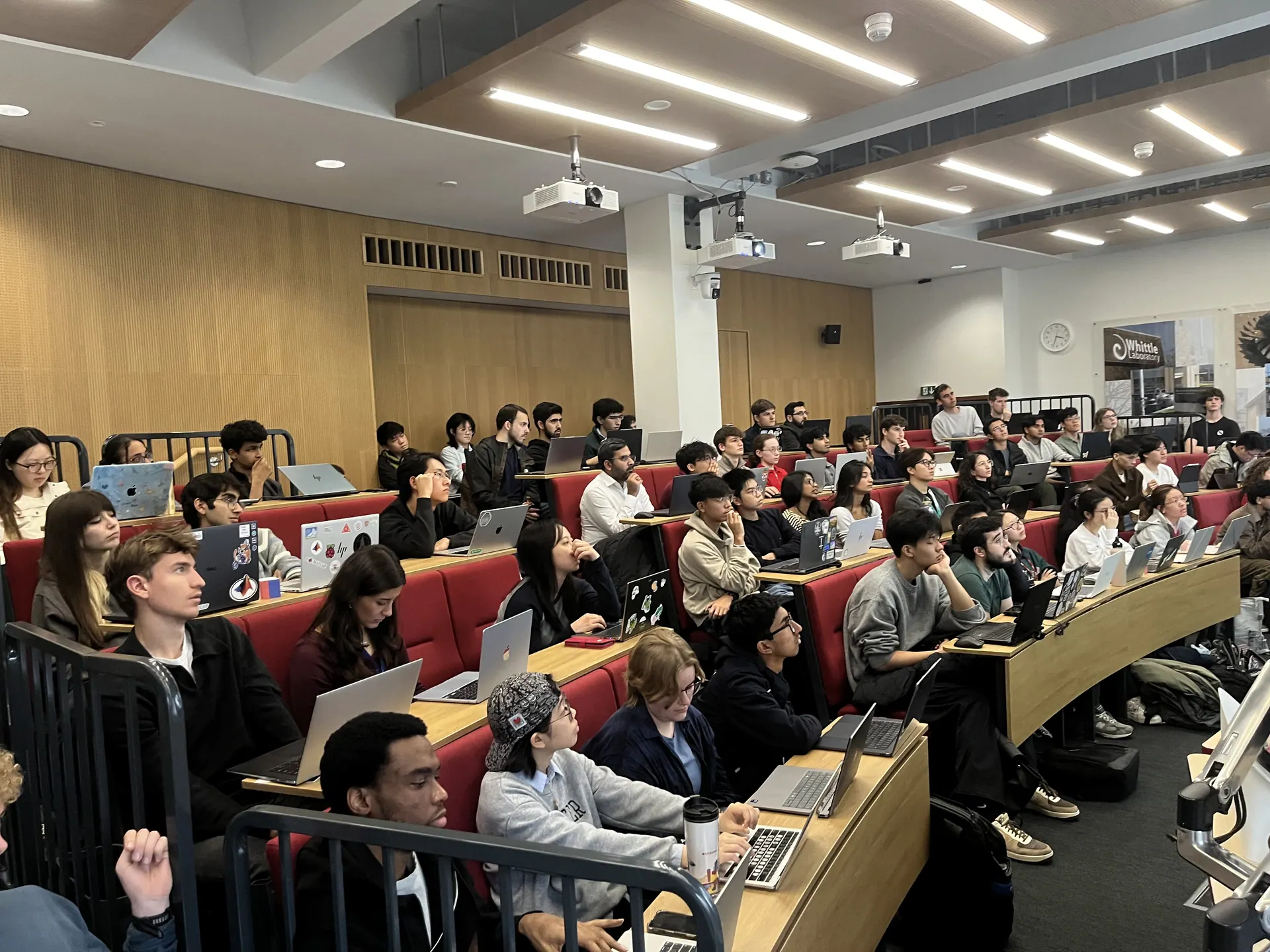
On Wednesday 21 October 2026 we ran a workshop for Cambridge students in a lecture theatre. The students joined one Vulkos group, created on 8 October, and worked on their own laptops in the browser.
The session was built from what we learned at two earlier workshops, in Bristol and Riga. It had three hands-on blocks, each a short slide followed by an exercise, and the presenters moved round the room instead of talking through the labs.
What they did on Vulkos
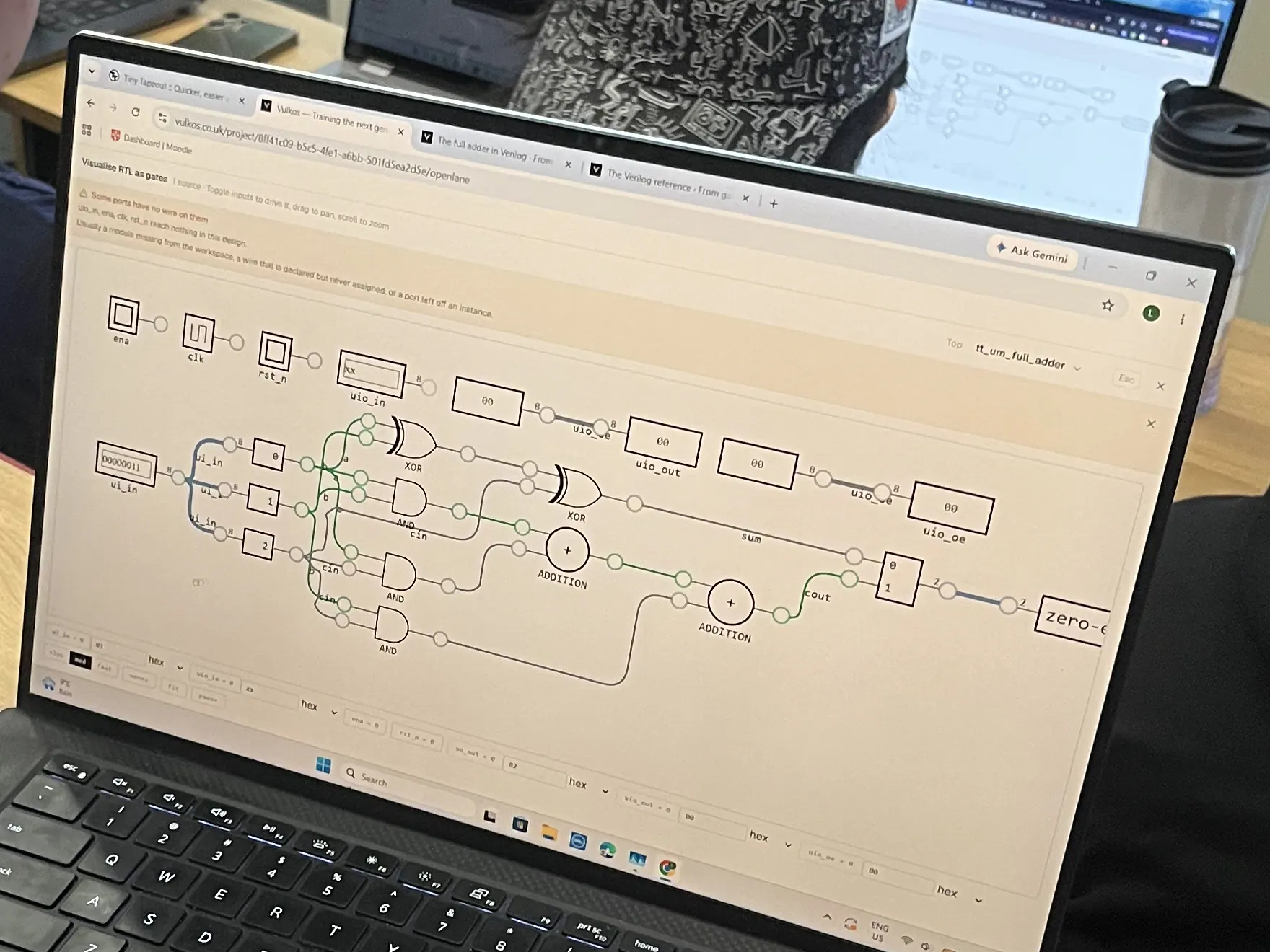
The session ran the whole path in miniature. Students drew a full adder from logic gates, wrote the same circuit in Verilog and checked it against a testbench, then ran it through the chip flow and opened the layout in 3D. A second exercise changed a width setting from 1 bit to 64 to show how a design grows. Students who were ahead could change a VGA racing game.
Of the 71 students, 70 ran at least one job and 69 finished a chip layout. 65 of those finished on the day. The median time from a student’s first action to their first finished layout was 30 minutes. That was inside a guided session, so read it as the time for a taught lab, not for someone working alone. 32 students used the assistant.
What came out of it
In the survey after the session, 33 of 43 respondents said yes to using Vulkos in their own course, lab or research group. Ten said maybe and none said no. Average agreement with “I could design a simple digital chip myself” went from 2.1 to 3.4 out of 5.
Students in the workshop group kept going after the room emptied. From the week after the workshop to Thursday 12 November there were 791 runs, 267 of them chip layouts, and 49% of the runs were outside 09:00 to 18:00 on weekdays. 24 students created 69 new projects, and 17 were active on five or more separate days.
A Cambridge MPhil module on VLSI is running its coursework on Vulkos this term, in place of Cadence.
We do not yet have marks or a comparison with last year, and student interviews are planned for around Christmas.
In their words
“As somebody that has taught lab courses, designing an introductory class lab using Vulkos could be very educational.”
Electronic and electrical engineering, Cambridge workshop “With Vulkos, I could start working on the problem without any of the tedious setup!”
Visiting student, Computer science, Cambridge workshop “I am a Mac OS user so being able to use LibreLane without setting up a Virtual Machine or using Docker was great.”
MPhil student, Electrical and electronic engineering, Cambridge workshop
More case studies
Run a workshop or a module with us.
Tell us the course, the size of the group and the term.