The world runs on chips
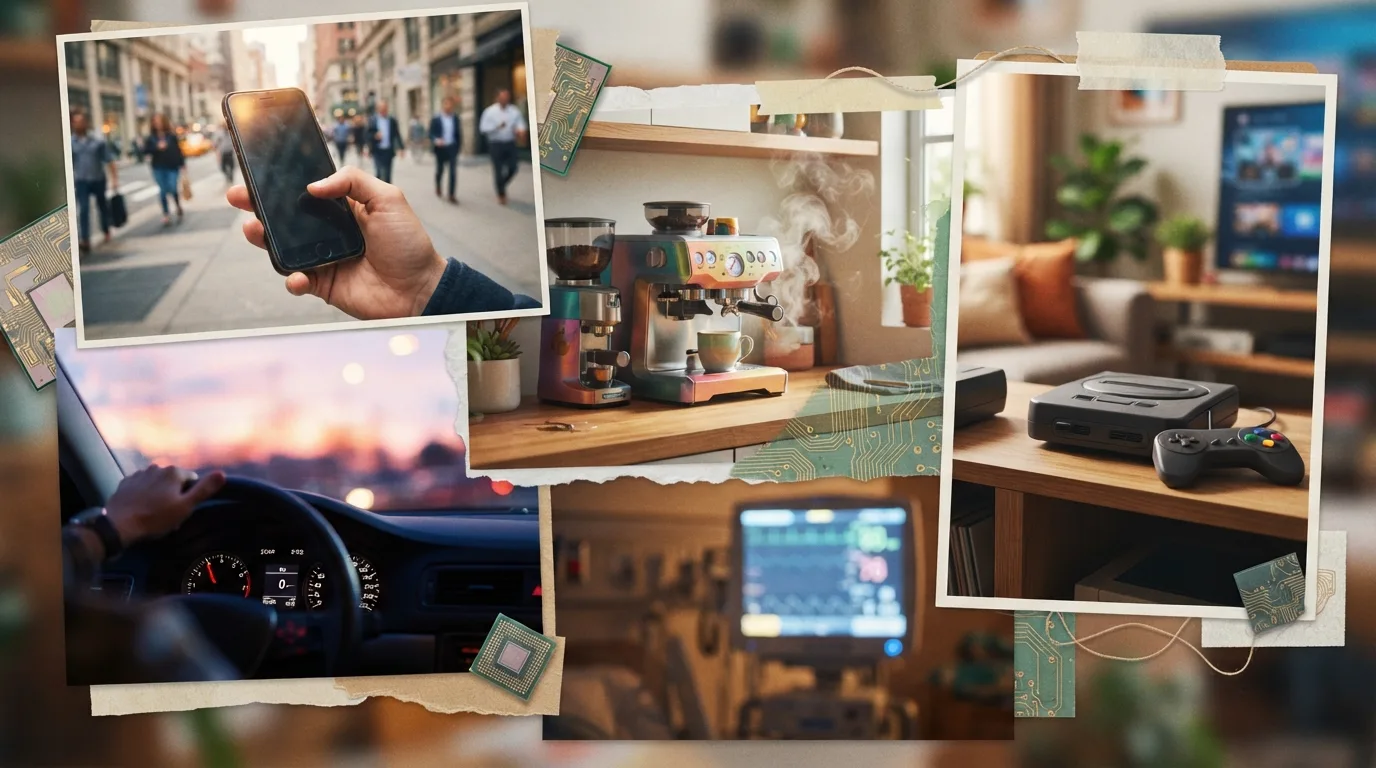
Almost everything computing near you is built from digital chips: your phone, your laptop, your car, the games you play and the servers behind every app and website. A single modern phone processor packs tens of billions of transistors onto a sliver of silicon smaller than a fingernail.
Figure: A collage of everyday digital devices arranged around a central silicon chip: a smartphone, a laptop, a car dashboard
This course teaches how that hardware is built, starting from a single wire and ending with circuits that count, choose, add and remember. This first module is the ground floor: signals, bits and logic.
CPUs, GPUs and the frontier
Two kinds of chip dominate the headlines:
- CPUs handle general work: your operating system, your apps, your browser.
- GPUs do enormous amounts of simple maths in parallel. They render games, and that same parallel power now trains the AI models that have started to change the world.
Figure: Two large die shots side by side, one labelled CPU with a few big complex cores
The industry designing these chips is worth hundreds of billions and grows every year. New AI accelerators, phone chips and car processors all come from the same skill you are starting now: digital design.
Two kinds of signal
One distinction runs through everything ahead: analogue versus digital.
An analogue signal varies smoothly and can take any value at all. Think of a sound wave or a slowly changing voltage. A digital signal is allowed only a few fixed values. In the digital world we use just two: 0 and 1.
Figure: A smooth sine wave on the left labelled "analogue: any value" and a clean square wave on the right labelled "digital: only high or low"
On the left, a smooth sine wave with infinitely many values. On the right, a square wave that only ever sits high or low. Digital design lives entirely in that second picture.
Analogue and digital devices
The same split shows up in everyday devices.
| Analogue | Digital |
|---|
| Vinyl record: the groove varies continuously | Smartphone: music stored as binary data |
| Dial thermometer: the needle can rest at any position | Digital thermometer: a numeric reading |
| Cassette tape: the magnetic signal varies continuously | Smartwatch: measurements shown as digital values |
Figure: A split panel. On the analogue side are a vinyl record, a dial thermometer and a cassette tape. On the digital side are a smartphone